



GeneGlobe ID: SMH-014AA | Cat. No.: 337021 | qBiomarker Somatic Mutation PCR Arrays
qBiomarker™ Somatic Mutation PCR Array Human PI3K-AKT Signaling Pathway
Product Specification
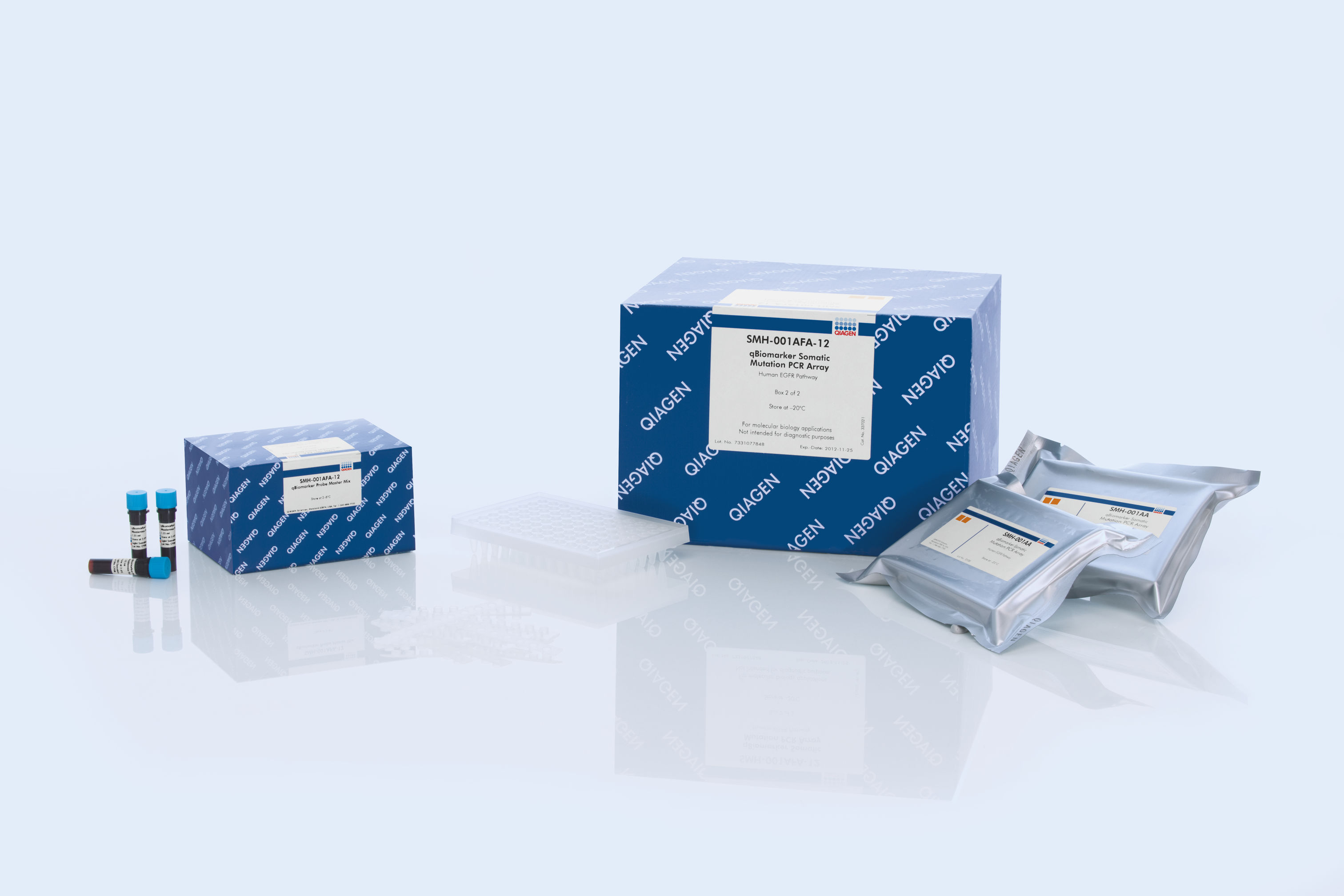
PCR plate and master mix
Target List
AKT1
The best known AKT1 mutations are c.49G>A, p.E17K, a PH domain mutation that results in constitutive targeting of AKT1 to plasma membrane, and an activating mutation, c.145G>A, p.E49K.
AKT3
The mutation assay detects an activating AKT3 mutation c.511G>A, p.G171R.
PIK3CA
The most frequently detected PIK3CA gain-of-function mutations occur either in the kinase domain (T1025-G1049, such as H1047L and H1047R) that increase its activity or in the helical domain (P539-E545) which mimic activation by growth factors.
PIK3R1
The mutation assays detect two recurrent disinhibitory PIK3R1 mutations, c.1126G>A, p.G376R and c.1690A>G, p.N564D, the latter of which causes increased basal kinase activity and lipid binding.
PIK3R5
The mutation assay detects a recurrent oncogenic mutation in PIK3R5.
PTEN
The most commonly detected PTEN loss-of-function mutations either truncate the protein (such as K6fs*4, R130*, R130fs*4, R233*, P248fs*5, and V317fs*3) or cause phosphatase inactivation (such as those at R130 and R173).
STK11
The most commonly detected STK11 inactivation variants either are point mutations or truncate the protein.
Product Resources
File Size: 138.97 KBLanguage: English
Resources
Supplementary Protocols (7)
Download Files (1)
Safety Data Sheets (1)
Instrument Technical Documents (2)
Performance Data (3)
Kit Handbooks (1)
White Papers (1)
Articles (1)
Application Notes (1)
Certificates of Analysis (1)
seo_BottomDescription