
GeneGlobe ID: SMH-025AA | Cat. No.: 337021 | qBiomarker Somatic Mutation PCR Arrays

qBiomarker™ Somatic Mutation PCR Array Human Brain Cancers

Product Specification

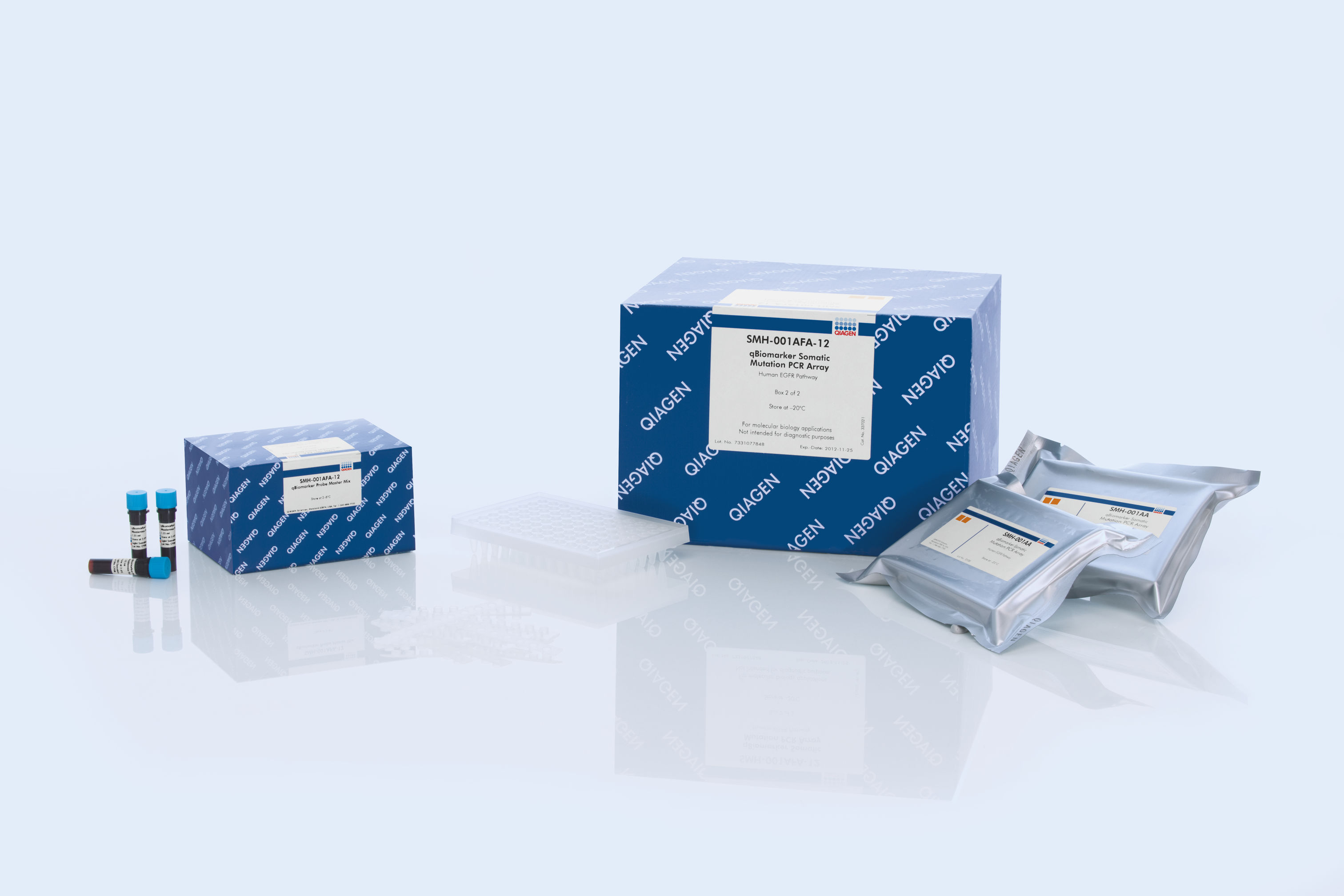
PCR plate and master mix

Target List

BRAF
Common point mutations in BRAF either increase kinase activity, such as L597V, L597Q and V600E, or inhibit kinase activity, such as G464V, G466V and G469A.
CTNNB1
The most frequently detected CTNNB1 mutations result in abnormal WNT signaling activity. The mutated codons are mainly several serines and threonines targeted for phosphorylation by GSK3B.
EGFR
These assays detect the most frequently identified EGFR mutations, which include P-loop and activation loop point mutations, kinase domain deletions, and insertion mutations.
IDH1
Most of these mutations abolish magnesium binding and alter the enzyme's activity to convert alpha-ketoglutarate into R(-)-2-hydroxyglutarate instead of isocitrate into alpha-ketoglutarate.
IDH2
These mutations all lie in the substrate binding domain, and one (p.R140Q) is associated with D-2-hydroxyglutaric aciduria.
KRAS
The mutation assays detect the most frequently occurring KRAS mutations in codons 12, 13, and 61. Mutations at these positions reduce the protein’s intrinsic GTPase activity and/or cause it to become unresponsive to RasGAP.
NF2
NF2 is similar to some members of the ERM family of proteins (ezrin, radixin, moesin) and links cell-surface proteins with cytoskeletal components and proteins involved in cytoskeletal dynamics. Mutations in this gene are associated with neurofibromatosis type II which is characterized by nervous system and skin tumors and ocular abnormalities.
NRAS
The mutation assays detect the most important NRAS variants, all found in codons 12, 13, and 61.
PIK3CA
The most frequently detected PIK3CA gain-of-function mutations occur either in the kinase domain (T1025-G1049, such as H1047L and H1047R) that increase its activity or in the helical domain (P539-E545) which mimic activation by growth factors.
PTEN
The most commonly detected PTEN loss-of-function mutations either truncate the protein (such as K6fs*4, R130*, R130fs*4, R233*, P248fs*5, and V317fs*3) or cause phosphatase inactivation (such as those at R130 and R173).

Resources

Download Files (1)
Data analysis file for qBiomarker™ Somatic Mutation PCR Array Human DNA QC Pathway- FFPE Samples
Catalog number- 337021
Pathway number- SMH-999
Safety Data Sheets (1)
Instrument Technical Documents (2)
For gene expression and genomic analysis
For screening disease-focused mutation panels by PCR
Kit Handbooks (1)
For real-time PCR-based, pathway- or disease-focused somatic mutation profiling
Certificates of Analysis (1)
Introducing the qBiomarker™ Somatic Mutation PCR Array Human Brain Cancers, a cutting-edge addition to our qBiomarker Somatic Mutation PCR Arrays lineup, specifically designed for Mutation/Variant Detection applications. This premium product offers unparalleled performance for researchers working with Human models. Leveraging advanced technology, the qBiomarker™ Somatic Mutation PCR Array Human Brain Cancers facilitates accurate and reliable results, making it an indispensable tool for your scientific investigations. Whether you're conducting Mutation/Variant Detection, or any other sophisticated analyses, this product from our qBiomarker Somatic Mutation PCR Arrays collection ensures optimal efficiency and reproducibility for Human studies. Embrace the future of research with qBiomarker™ Somatic Mutation PCR Array Human Brain Cancers and elevate your work to new heights.